|
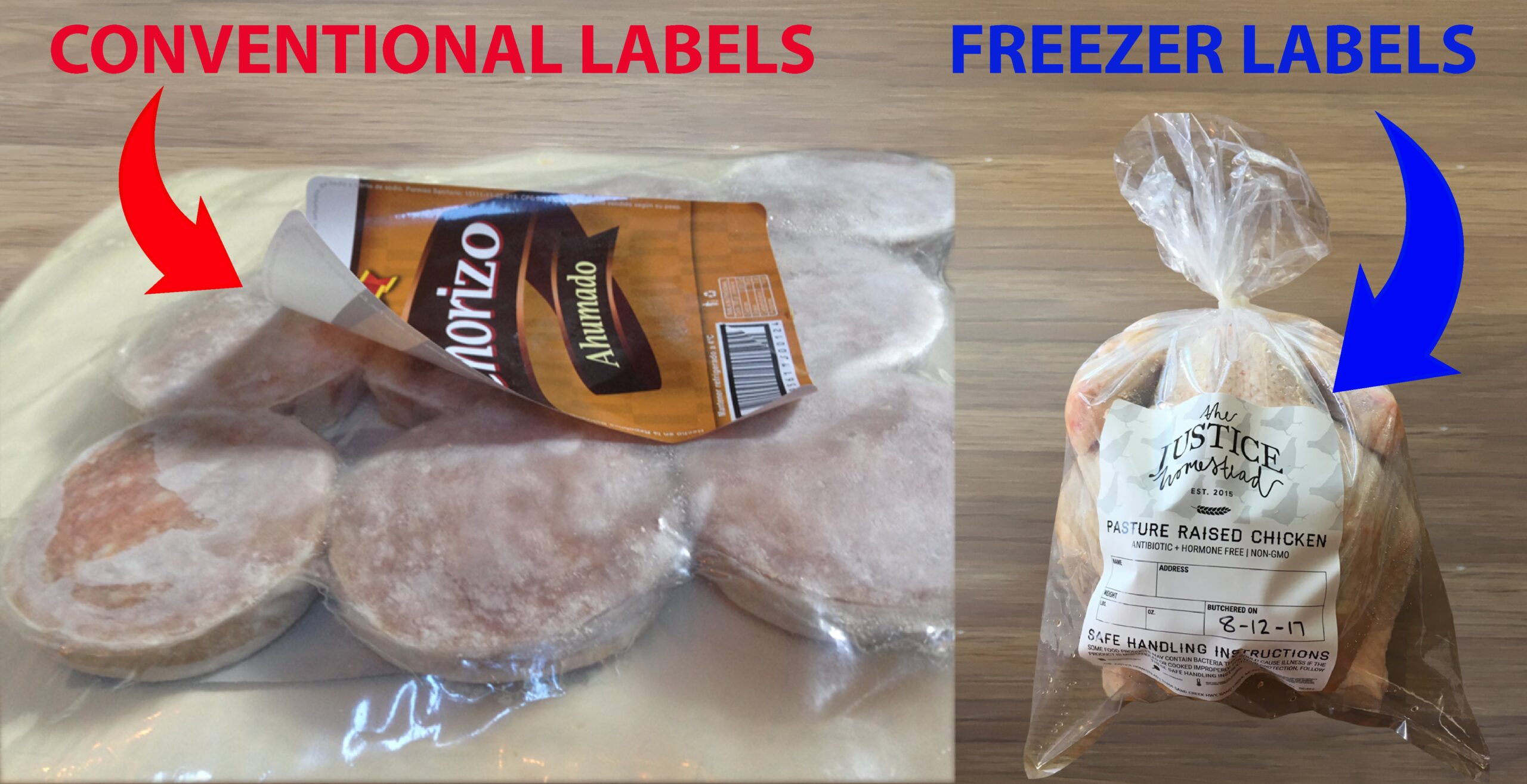
Freezer labels are used mostly for food packaging / storage and in laboratory settings. They stay adhered when frozen unlike standard labels, which fall off because general purpose adhesive deadens in cold temps. Freezer labels can also be used in industrial applications where they are exposed to the outdoor elements, ie. sub-zero environmental conditions. Some typical examples: (pre)frozen vegetable bags, cold storage distribution, cryogenic lab labels, outdoor pallet racking, etc…
All of our labels come with a PS self-adhesive coating (pressure sensitive). They need not be water or heat activated, ie. simply, peel-and-stick with firm pressure, hence ‘pressure sensitive’. Freezer labels typically fall under two categories of use: ‘dry conditions’ and ‘wet conditions’ For DRY, we use paper material specifically meant for cold/dry exposure. For WET, we use synthetic material (poly/vinyl) specifically meant for cold/wet exposure, ie. condensation, frost, etc...
There are a number of standard permanent adhesives that will stay adhered to certain surfaces when frozen if the circumstances are ideal. For instance, if a permanent label is allowed a 24-hour adhered set-period at room temperature before freezing -- chances are it will stick. Home based businesses and start-up ventures have the flexibility of creating ideal circumstances to save from having to upgrade to an actual FREEZER adhesive. Some, even doctor up remedies to ail fallen/pealing labels: wrap around packing tape, extra spray on industrial adhesive, extensive application pressure, towel (pre)wipe and re-stick, etc... With larger, commercial applications, these measures are simply cost prohibitive and timely outweighing the cost of freezer grade adhesive.
USES FOR FREEZERGRADE LABELS
1. Cold storage and distribution
2. Blast freezing / industrial kitchen
3. Cryogenic lab environment, ie. nitrogenexposure
4. Outdoor elements, zub-zero
5. (PRE)frozen food packaging
6. Corrective labeling on frozen surfaces
7. Co-packing, perishables
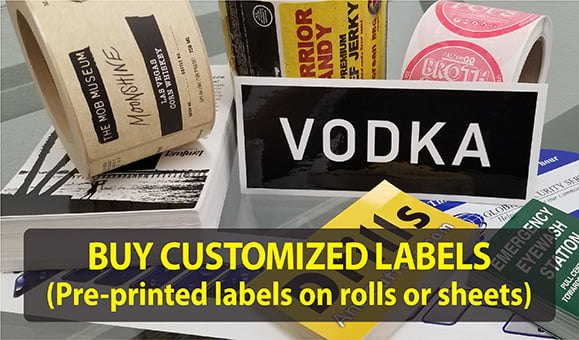
Freezer labels are available in either blank preset templates, so you can print yourself or, preprinted and ready to apply. They can also come in both roll or sheet format depending on your application.
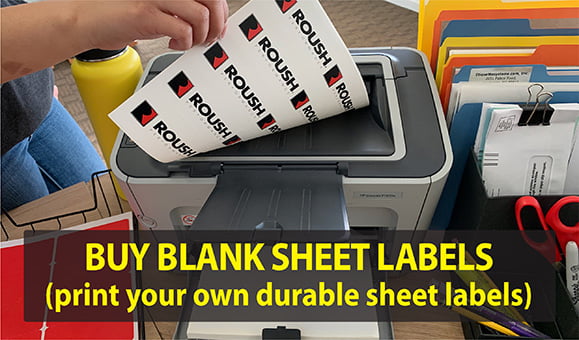
Blank Sheet Labels with Freezer Adhesive, are a great solution for do it yourself shoestring budgets where small quantities and multiple varieties play a major factor. We offer these labels with freezer adhesive coated on either paper or vinyl stock.
1. Paper sheet labels (matte) with Freezer Adhesive: labels will run through both laser and inkjet printers. Meant for use in cold/dry applications. Paper labels have limited resistance to moisture exposure, ie. condensation, especially if printed through inkjet process.
2. Vinyl sheet labels (matte) with Freezer Adhesive: labels will run through a laser printer only, black or color toner. These labels are substantially more costly vs. paper substrate(s) but, a great solution for high moisture exposure. And, vinyl labels can even be submerged in ice-cold water.
Blank Roll Labels with Freezer Adhesive, are meant to run through digital printers that can accommodate coiled labels, ie. spooled on a core. There are several advantages of using freezer labels on rolls especially in commercial application. First, freezer adhesives are generally more aggressive on rolls. And, there are tremendously more freezer adhesive / substrate combinations available on roll labels vs. sheets. Also, handling roll labels is easier then peeling them off sheets. They can even be machine applied for automatized applications. Some typical examples of roll label printers: thermal transfer, direct thermal, continuous inkjet/laser.
‘stock’ usually pertains to total construction, ie. face/adhesive/liner. ‘substrate’ usually refers to face layer only, ie. surface material (paper, poly, vinyl, etc...)
the adhesive component of a label material (stock) is what determines whether it is freezer grade. There are many substrates (facestocks) that are compatible with freezer grade adhesives.
FACESTOCKS
…typically used for freezer grade applications
Semi-Gloss (paper) used to produce preprinted roll labels,which usually come varnished or laminated for better moisture resistance. Not meant for do it yourself desktop printing.
Matte Laser (paper)used to produce sheet labels that usually come blank but can be ordered with preprinting. Will work through either laser or inkjet desktop printers, Meant for use in dry application(s).
Thermal Transfer (paper) used to produce blank or preprinted roll labels. Designed solely to run through TT(monochromatic) printers. Offers only a limited amount of moisture resistance.
4 Mil Laser Vinyl used to produce ‘print yourself’ weatherproof sheet labels. Most usually come blank but can be ordered with preprinting. Will work through laser printers only – not inkjet.
2.3 Mil White BOPP (polypropylene)used to produce blank or preprinted roll labels. A great material solution for food packaging exposed to condensation. Excellent moisture resistance. If supplied blank, meant to run through TT (monochromatic) printers. Not recommended for outdoor applications.
FREEZER GRADE ADHESIVES
C2075 a true freezer grade adhesive designed for challenging‘hard to sick’ cold-temperature conditions.
• Type: Hot Melt Rubber
• Minimum Application Temperature: 0° F
• Service Temperature Range: -65° F to +160° F
AT20 an all-temperature adhesive designed to work at both room and cold temperatures. Commonly used in cool warehouseenvironments for adhering labels to corrugated boxes. Compliant with FDA 175.105 (incidental with food).
• Type: Emulsion Acrylic
• Minimum Application Temperature: -20° F -29° C
• Service Temperature Range: -65° F to +200° F
AT20B consider an all-purpose (tacky) cold temperature adhesive.This is the heavy coat-weight version of AT20.
• Type: Emulsion Acrylic
• Minimum Application Temperature: -20° F -29° C
• Service Temperature Range: -65° F - 200° F
FA20 is specifically designed to be used in freezers. Labels coated with this adhesive can be adhered to packaging that is already frozen. FA20 is often used for labeling to waxy-coated corrugated boxes.Also compliant with FDA 175.105 (incidental with food).
• Type: Hot Melt Rubber
• Minimum Application Temperature: 0° F -18° C
• Service Temperature Range: -65° F to +160° F
C0196 is a permanent solvent acrylic cryogenic adhesive. Developed to adhere to glass and plastic that is exposed liquid nitrogen. C0196will also endure dry ice, steam autoclave and gamma radiation.
• Type: Solvent acrylic
• Minimum Application Temperature: -20° F
• Service Temperature Range: -196° C (-320F) to +90°C (+190° F)
|