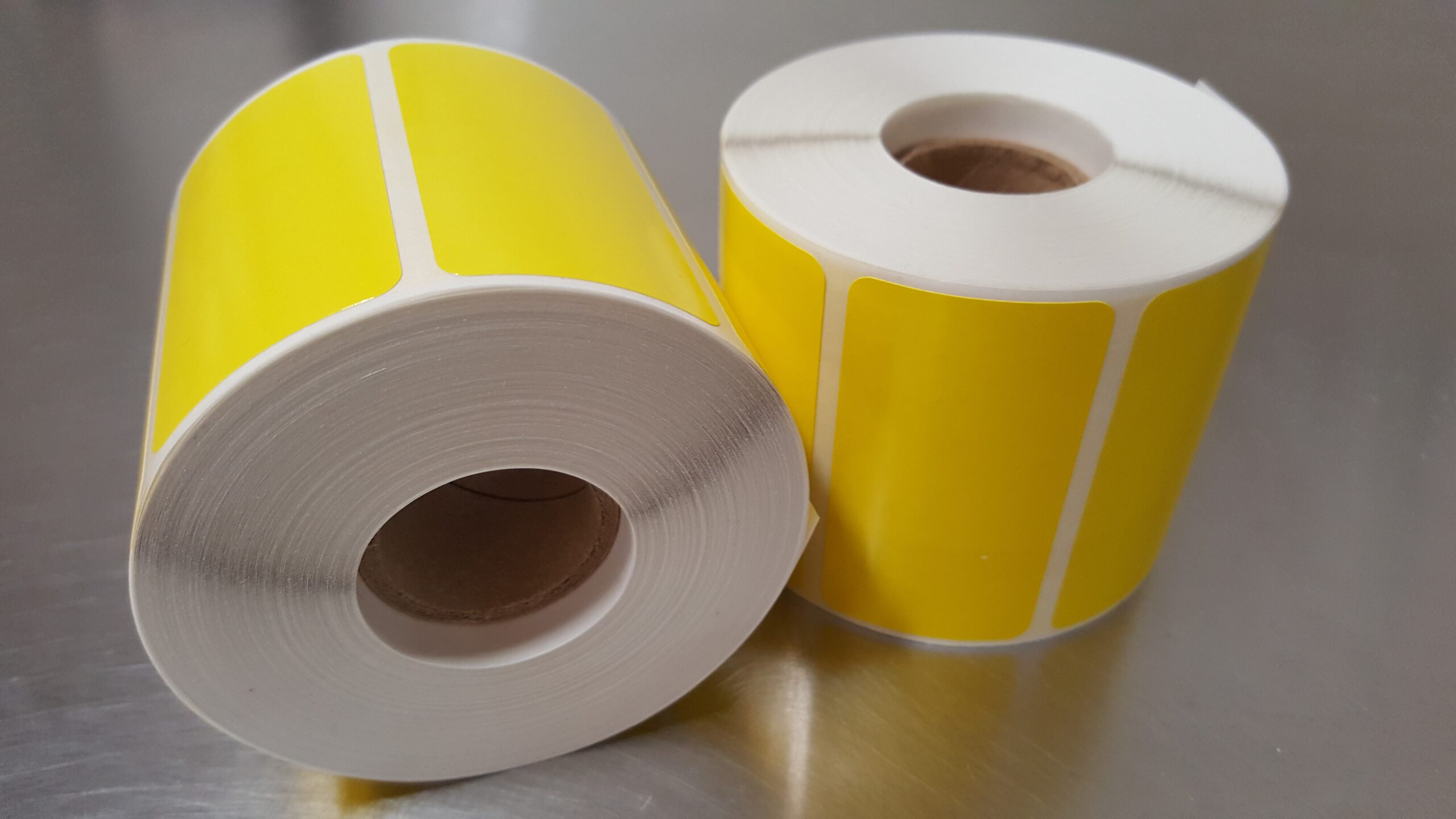
 When shopping for roll printer labels, it’s important to realize the differences between direct thermal labels and thermal transfer labels. Although their descriptions are similar, entirely different consumables are used to transfer images onto substrates. Thermal transfer technology uses a heated printhead to transfer ink from a coated ribbon to label substrate. The direct thermal process uses a heated printhead to directly form an image on heat-sensitive stock. Thus, with a direct thermal label, there’s no ribbon involved.
Here’s how it works, in a nutshell: direct thermal labels are coated with a heat-sensitive chemical that darkens when the printhead pins are heated to over 185˚ F and make direct contact with the label surface. Different types of direct thermal labels use different chemicals to produce an image. Whatever DT label coating is utilized, the resulting image is a monochromatic, and normally black. However, some specialty DT labels can yield other colors: that is, blue or red rather than black. Multicolor printing isn’t possible with print your own DT labels.
Direct thermal labels have their limitations, but one of the main benefits of using them is reduced cost of consumables; you don’t have to worry about ribbons at all. In fact, direct thermal labels are usually better-priced then other forms of blank labels, typically because they’re only meant for short-term use.
Our direct thermal labels come in a wide range of varieties. Most are paper, but some of our blank DT stickers are made of synthetic, moisture-resistant materials. The heat-sensitive coating also comes in degrees of sensitivities: low, medium, and high.
Unsurprisingly, direct thermal labels don’t fare well in very hot environments, whether outdoors or in industrial settings, because the labels and print discolor, obscuring the image. There is, however, a special-order DT label material, commonly referred to as “hotbox,” that is commonly used for labeling preheated ready-to-eat foods. These DT labels are specifically designed to sit under heat lamps without discoloring. On the other end of the thermostat, we also offer DT labels with freezer/food-grade adhesives.
The sky’s the limit when it comes to options available for direct thermal labels—so we look forward to learning your specific application needs!